Software & Tools · Buyer’s Guide
From free Google dashboards to $500-a-month agency suites, the price ladder in SEO software is steeper than ever. We break down where the money goes — and where it quietly disappears.
Somewhere between “SEO tools are free, just use Search Console” and “our agency spends $1,500 a month on Ahrefs Enterprise” sits the truth, and almost nobody writes about it honestly. Most comparison articles are written by affiliates who earn 30–40% commission on whichever tool they push hardest. That’s not a conspiracy theory; it’s just how the SEO content economy works, and it explains why every roundup somehow concludes that a $249/month plan is “the obvious choice for serious marketers.”
I’ve paid for most of these tools out of my own pocket at one point or another, cancelled a few of them in mild irritation, and gone crawling back to at least one. So this guide takes a different angle: instead of ranking tools against each other, it ranks price tiers. What does $0 buy you? What does $29 buy you? What suddenly unlocks at $129, and is the jump to $249 actually worth the extra hundred and twenty dollars, or is it mostly bigger numbers on a limits page you’ll never hit?
All prices below were checked against the vendors’ own pricing pages in August 2026. Several of them changed this year — Ahrefs restructured its plans and raised prices in the spring, and Semrush now pushes a whole separate “Semrush One” bundle with AI visibility tracking — so if you’re reading an article from 2024, throw it away.
Tier Zero: Completely Free $0 / month
Let’s start with the uncomfortable fact the paid-tool industry would rather you skip past: the single most important SEO tool in existence costs nothing. Google Search Console is the only place on earth where Google tells you, directly, which queries your pages appear for, what position they hold, and how often people click. Every paid rank tracker is an approximation of this data. Search Console is the data.
What it won’t do is tell you anything about anyone else’s website. That’s the entire business model of the paid tools in one sentence: you pay for competitor data. Keep that framing in your head for the rest of this article, because it explains almost every pricing decision you’ll see below.
The free tier is deeper than most beginners realize:
Ahrefs Webmaster Tools (Ahrefs Free) gives verified site owners limited access to Site Explorer and Site Audit for their own domains. You get real backlink data on your own site — the same index paying customers use — just capped and restricted to properties you can verify. For a small publisher who mainly wants to see who’s linking to them, this is genuinely enough for a year or two.
Bing Webmaster Tools (bing.com/webmasters) is the perennially ignored sibling, which is a shame because its keyword research tool has no daily lookup limit and its site scanner is a passable free technical auditor. Bing also matters more than it used to, since its index feeds several AI search products.
PageSpeed Insights (pagespeed.web.dev) covers Core Web Vitals with real-user Chrome data, which no paid tool can replicate because Google simply doesn’t sell that dataset to them.
Screaming Frog’s free version crawls up to 500 URLs per crawl. For a site under 500 pages, that’s a full technical audit — broken links, redirect chains, duplicate titles, missing meta descriptions — at zero cost.
Tier One: The Budget Bracket $20 – $50 / month
This is the most interesting tier right now, because it barely existed five years ago. The big platforms used to start at $99+ and left the low end to scrappy underdogs. That’s changed.
Ahrefs Starter — $29/month
The surprise entry. Ahrefs, historically one of the most expensive tools on the market, now sells a $29/month Starter plan. You get real Ahrefs data — the same backlink index, the same keyword database — on a tight credit ration. And it is tight. Every report you open burns credits, and heavy research sessions will drain a month’s allowance embarrassingly fast. But as a way to spy on two or three competitors a few times a month, it’s the best data-per-dollar deal in the industry. Note there’s no free trial on the bigger Ahrefs plans, so Starter doubles as the cheap way to test whether you like the platform before committing to $129+.
Mangools — from around $30/month
Mangools is the tool people describe with the word “pleasant,” which sounds like faint praise until you’ve spent a week inside Semrush’s interface. Its Basic plan runs $29.90/month on annual billing, and the suite (KWFinder, SERPWatcher, LinkMiner, and friends) does keyword research and rank tracking with the friendliest UX in the category. Two real limitations: daily lookup caps rather than monthly ones, which punishes binge-research sessions, and — the bigger one — no site crawler at all. Mangools cannot audit your site’s technical health. If you buy it, budget for Screaming Frog alongside it.
Screaming Frog SEO Spider — £199/year (~$279, about $23/month)
Different animal entirely. Screaming Frog is a desktop crawler, licensed annually per user, not a cloud subscription. The paid license removes the 500-URL cap, unlocks JavaScript rendering, custom extraction, scheduling, and API hookups to Search Console and Analytics. It does zero keyword research and zero backlink analysis — it’s a scalpel, not a Swiss Army knife — but for technical audits it remains the industry standard, and agencies billing thousands per month for audits are, quite often, running this $279-a-year program under the hood. The interface looks like accounting software from 2009. Nobody cares. It works.
Ubersuggest — from $29/month
Ubersuggest is the entry drug of SEO tools, and Neil Patel’s marketing machine makes sure you’ve heard of it. It covers keywords, basic audits, and basic backlinks at a genuinely low price, and it periodically offers a lifetime deal that’s hard to argue with for a hobby site. The trade-off is data depth: its backlink index is noticeably thinner than Ahrefs’ or Semrush’s, and users with growing sites tend to outgrow it within a year. Fine starting point; poor destination.
Tier Two: The Professional Middle $100 – $250 / month
Here’s where the industry actually competes, and where the pricing gets genuinely confusing — partly, one suspects, on purpose.
Ahrefs Lite — $129/month
Ahrefs’ entry “real” plan gives you 5 projects, 750 tracked keywords, 100,000 crawl credits for site audits, and 6 months of historical data. Sounds generous. The catch, and the single most common complaint in every Ahrefs discussion thread: Lite still runs on the credit system, with 1,000 credits per user per month. Open reports carelessly and you can exhaust a month’s credits in a weekend. The other notable gap is Content Explorer — Ahrefs’ database for finding link prospects and popular content — which is simply not included at this level. It unlocks at Standard. This feels less like a technical limitation and more like a deliberately placed upgrade incentive, because it is one.
Semrush Pro — $139.95/month
Semrush Pro takes the opposite approach: instead of deep data with usage credits, you get an enormous breadth of features with hard numeric caps — 5 projects, 500 tracked keywords, and a set number of reports per day. Where Ahrefs is an SEO tool, Semrush is a full marketing platform: PPC research, social scheduling, listing management, the works. For SEO-only work, plenty of the interface is furniture you’ll never sit on. But if you also run Google Ads, the advertising research alone can justify the fee. One 2026 wrinkle: AI visibility tracking (how your brand shows up in ChatGPT, Perplexity, and Google’s AI results) costs an extra $99/month as an add-on, or you can move to the newer Semrush One bundles starting around $199/month. Watch that upsell; it’s aggressive.
SE Ranking Core — $103.20/month annual ($129 monthly)
SE Ranking is the tool that mid-sized agencies quietly switched to while everyone argued about Ahrefs versus Semrush. Its Core plan covers 10 projects, generous daily keyword checks, a 250,000-page monthly audit allowance, and — unusually at this price — white-label reporting included, plus AI search tracking at no extra charge. The databases aren’t quite as deep as the big two’s, and you’ll notice it on smaller or non-English niches. But the value calculation is hard to beat: it does roughly 80% of what Ahrefs does at 40–60% of the cost, and it offers a real 14-day free trial, which Ahrefs pointedly does not.
Moz Pro — $49 to $299/month
Moz Pro spans this tier awkwardly, with plans from Starter ($49) through Standard ($99) and Medium ($179) up to Large ($299) on annual billing. Moz invented Domain Authority, which remains the metric every link seller quotes at you, and its keyword tool is genuinely beginner-friendly. The honest assessment, shared by a lot of long-time users: the platform has fallen behind Ahrefs and Semrush on data freshness and index size, and at Medium-plan prices you’re paying big-two money for third-place data. The 7-day free trial with full Medium access is a fair way to judge for yourself.
“The mid tier isn’t selling you features. It’s selling you the removal of anxiety about limits — and then adding new limits to sell the next tier.”
Tier Three: The Agency Bracket $250 – $500 / month
The jump into this tier is where you should slow down and do actual math, because the upgrade pitch here is mostly about limits, and limits only matter if you hit them.
Ahrefs Standard — $249/month
This is the plan working SEOs actually mean when they say “just get Ahrefs.” Credits become unlimited per user, which alone dissolves the biggest Lite frustration. You get 20 projects, 2,000 tracked keywords, 500,000 crawl credits, 2 years of historical data, and — finally — Content Explorer, along with batch analysis and broken-link reports that make link building workflows dramatically faster. Extra seats cost $60/month each, which adds up quicker than teams expect. If your income depends on SEO deliverables, this is the tier where Ahrefs stops fighting you.
Semrush Guru — $249.95/month
Semrush’s own data reportedly shows Guru is its most popular plan, and the reason is the Content Marketing Toolkit: SEO content templates, topic research, content audits, plus historical data access and 1,500 tracked keywords across 15 projects. For content-driven businesses — publishers, affiliate sites, anyone shipping several articles a week — the content tooling replaces separate subscriptions that would cost $100+ on their own. For a purely technical SEO or link builder, Guru’s extras are less compelling and Ahrefs Standard wins on data.
SE Ranking Growth — $223.20/month annual
Adds 30 projects, three manager seats, historical data, API access, and a 2-million-page audit allowance. Agencies juggling 15–25 smaller clients on white-label reports get more raw capacity per dollar here than anywhere else in the tier.
Semrush Business — $499.95/month
Sitting at the top of self-serve pricing: 40 projects, 5,000 tracked keywords, API access, Share of Voice metrics, and higher limits across the board. Most buyers at this level are agencies with reporting obligations or in-house teams at companies where $500/month is a rounding error. If you’re an individual reading a price-tier comparison article, this plan is not for you, and that’s fine.
Tier Four: Enterprise $1,000+ / month, usually custom
Ahrefs Enterprise lists at $1,499/month with an annual commitment; Semrush Enterprise is quote-only. What the money buys is rarely more SEO data — it’s organizational plumbing: single sign-on, audit logs, access management, uncapped API usage, contractual support. Enterprise SEO pricing is a procurement exercise, not a product comparison, and everything at this level is negotiable. If you’re big enough to need it, your finance team already knows this.
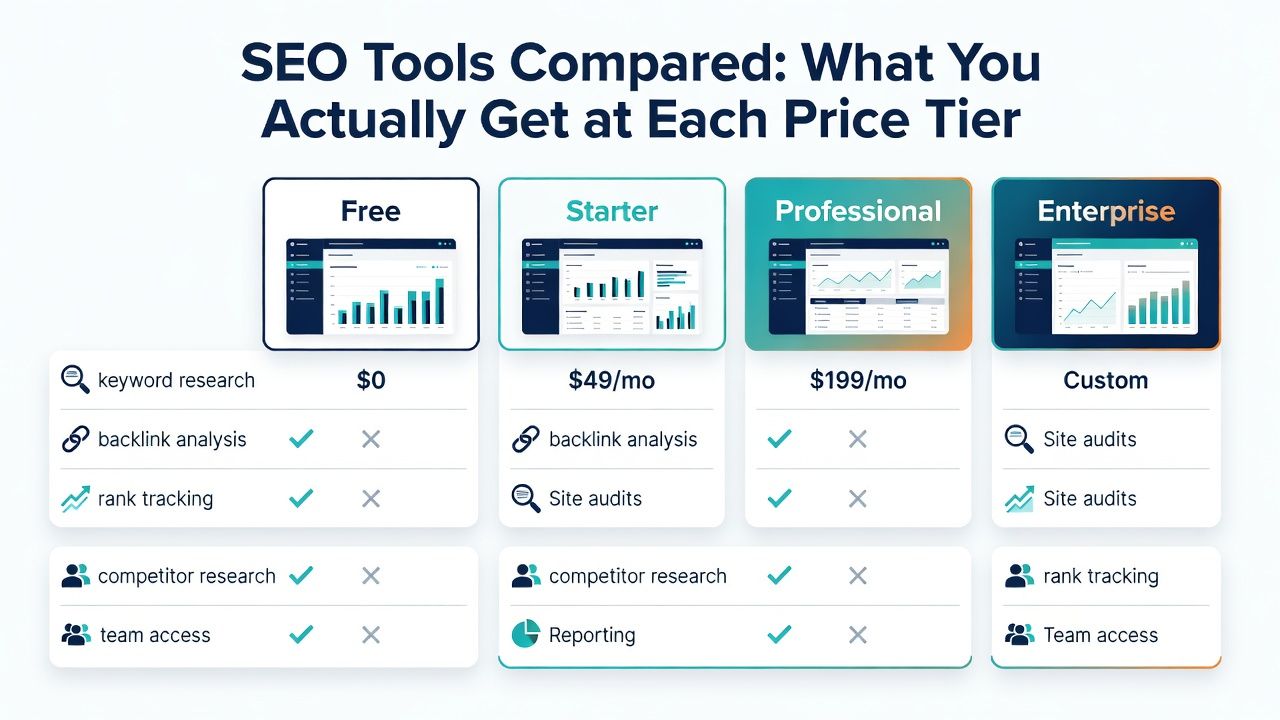
The Tier-by-Tier Cheat Sheet
| Tier | Typical Cost | Best Options | What You Actually Get | The Catch |
|---|---|---|---|---|
| Free | $0 | Search Console, Ahrefs Free, Bing WMT, Screaming Frog (free) | Full data on your own site; audits under 500 URLs | Zero competitor data, zero keyword volumes |
| Budget | $20–50 | Ahrefs Starter, Mangools, Screaming Frog paid, Ubersuggest | Real keyword & backlink data, rationed; unlimited technical crawling | Credits/daily caps; thin indexes at the cheapest end |
| Professional | $100–250 | SE Ranking Core, Ahrefs Lite, Semrush Pro, Moz Pro | Multi-project tracking, serious research volume, audits at scale | Key features gated for the next tier up |
| Agency | $250–500 | Ahrefs Standard, Semrush Guru, SE Ranking Growth | Unlimited/near-unlimited usage, historical data, content tooling | Per-seat fees stack; you pay for capacity you may not use |
| Enterprise | $1,000+ | Ahrefs Enterprise, Semrush Enterprise | SSO, audit logs, uncapped API, contracts | You’re buying compliance, not better SEO data |
The Costs Nobody Puts on the Pricing Page
Sticker price is the beginning of the conversation, not the end. Four things reliably inflate the real bill:
Seats. Almost every plan above includes one user. Ahrefs charges $40–$80/month per additional seat depending on tier. A three-person team on Ahrefs Standard isn’t paying $249 — it’s paying $369+. Screaming Frog licenses are strictly per user too: two people crawling means two licenses.
Credits and overages. Ahrefs’ pay-as-you-go credits, Semrush’s report caps, Mangools’ daily lookups — every vendor meters something, and the meters are calibrated so that engaged users bump into them. Before subscribing, find the limits page (it’s always three clicks deeper than the pricing page) and compare it against how you actually work.
Annual lock-in. The advertised prices are usually annual-billing prices. Monthly billing runs 17–35% higher. Annual plans are also, almost universally, non-refundable. The discount is real; so is the handcuff.
The stacking trap. Cheap tools have gaps, and filling gaps costs money. Mangools ($30) plus a content optimizer ($89) plus Screaming Frog ($23/month equivalent) lands you at $142/month — more than SE Ranking Core, which covers all three jobs. Sometimes the “expensive” all-in-one is the frugal choice. Run the total before assuming the low sticker wins.
So What Should You Actually Buy?
Brand-new site, no revenue yet: Nothing. Search Console + Ahrefs Free + Bing Webmaster Tools + the free Screaming Frog. Spend the money on content instead. Revisit this decision when you have traffic worth analyzing.
Growing blog or niche site: Ahrefs Starter at $29. Learn to live within the credits — it teaches discipline anyway. Upgrade the month the credit ceiling genuinely blocks work, not the month it merely annoys you.
Freelancer with 2–5 clients: SE Ranking Core. White-label reports at $103/month is the quiet bargain of the whole industry, and the trial costs you nothing to confirm it.
Content publisher shipping weekly: Semrush Guru, mostly for the content toolkit and historical data. Painful price, but it consolidates several subscriptions.
Link builder or technical SEO: Ahrefs Standard plus a Screaming Frog license. About $272/month combined, and honestly the strongest pure-SEO stack money can buy short of enterprise contracts.
Agency at scale: You already know the answer is “whichever platform your reporting workflow is built around,” because migration costs dwarf the subscription delta. Negotiate the renewal anyway; more of these prices bend than the vendors let on.
One closing thought. The gap between a $29 tool and a $249 tool is real, but it’s smaller than the gap between using either of them well and using either of them badly. I’ve watched sites on free Search Console data outrank competitors paying $500 a month, because the free-tool owner actually acted on what the data said. The subscription is the cheap part. The work is the expensive part. Price your time accordingly, then pick the tier that respects it.
Prices checked August 2026 against each vendor’s official pricing page and are subject to change — SEO tool pricing has been unusually volatile this year. This article contains no affiliate links; every link points to the vendor’s own site or a free Google/Microsoft property.