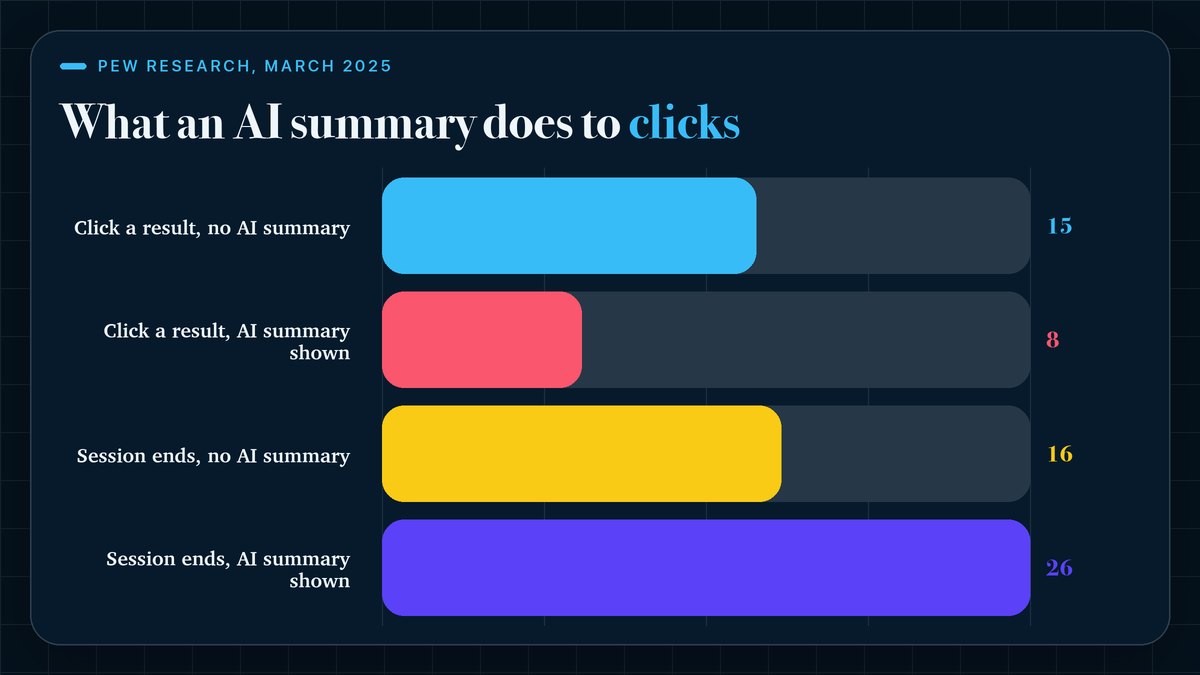
In March 2025, Pew Research Center tracked the browsing of 900 US adults and found that when Google put an AI summary on the results page, people clicked a traditional result link on only 8% of visits, against 15% of visits without a summary. Half the clicks gone, on the query types content sites depend on most. If a third to a half of your informational queries now end inside an answer box, then ranking third for them counts for less than being one of the three sources the box quotes, and almost none of the reporting tools you already pay for will tell you whether that’s happening.
This guide covers what AI search visibility actually means in late 2025, how ChatGPT, Perplexity, and Google’s AI Overviews each choose what to cite, which tracking tools earn their subscription, and a weekly workflow that fits a one-person marketing operation. It assumes you already do ordinary SEO; if you don’t, fix that first, because every answer engine on this list still leans on the classic search index.
In this article
The click is going missing, and the numbers are no longer anecdotal
Google switched AI Overviews on for US users at I/O on May 14, 2024, and pushed them to more than 100 countries that October. OpenAI launched ChatGPT search on October 31, 2024 and opened it to free accounts that December, while Perplexity’s chief executive said in mid-2025 that his engine was handling about 780 million queries a month. None of these products shows ten blue links as the main event, and that changes the arithmetic of content marketing in a way a rank tracker can’t see.
The Pew study is the cleanest public measurement so far because it used real browsing logs rather than surveys. Across 68,879 Google searches collected in March 2025, 18% produced an AI summary, and the rate climbed steeply with query shape. Only 8% of one- or two-word searches triggered one, while 53% of searches of ten words or more did, and 60% of queries starting with “who,” “what,” “when,” or “why.” Those long, question-shaped queries are exactly the ones content sites spent a decade optimizing for, so the format that used to be your safest traffic is now the format most exposed to the summary box.
Behavior inside those summary pages is worse than the headline click rate suggests. Pew found that users clicked a source cited inside the summary on just 1% of visits, and they ended their browsing session entirely after 26% of AI-summary pages, compared with 16% of ordinary results pages. The median summary ran 67 words, and 88% of summaries cited three or more sources, so the box does the reading for the user and compresses a dozen pages into a paragraph with footnotes most people never touch.
Two details in the same dataset point at the opening. Wikipedia, YouTube, and Reddit together accounted for 15% of the sources cited in AI summaries, and .gov pages made up 6% of cited sources against only 2% in ordinary results, which tells you the engines overweight sources they treat as authoritative and neutral. A commercial blog can still get quoted, but usually on the strength of a specific, checkable claim rather than another 2,000-word overview of a topic the model already knows.
How each engine decides what to cite
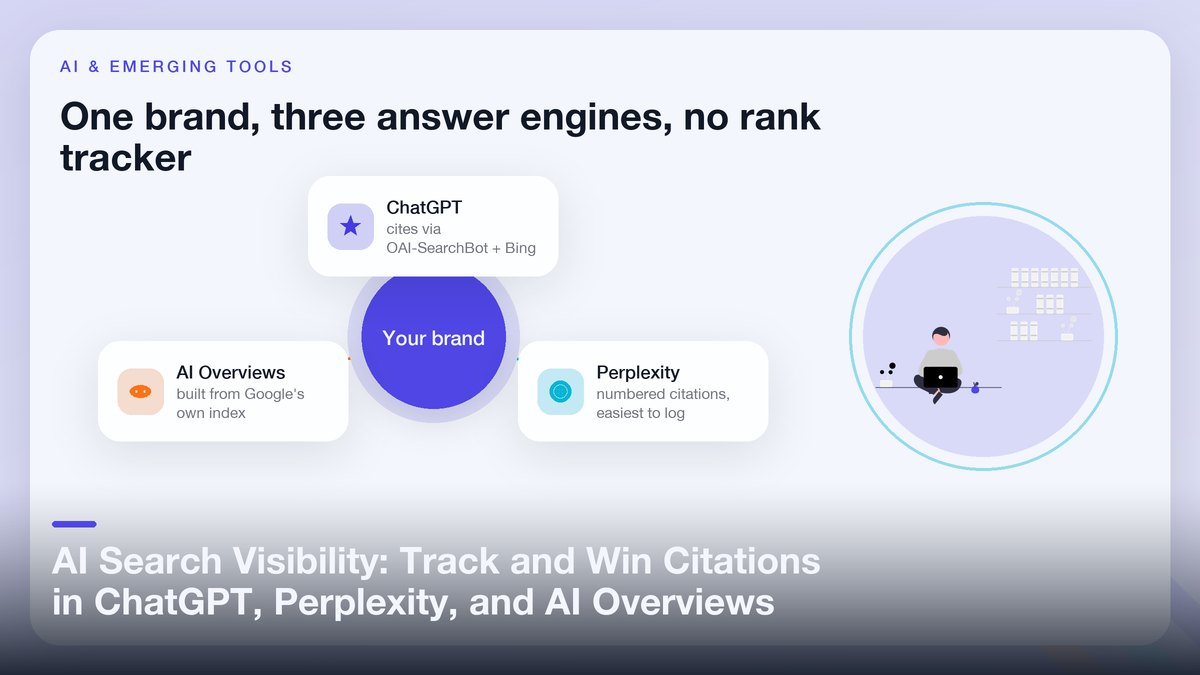
The three systems people lump together as “AI search” retrieve and cite in different ways, and the differences decide where your effort goes.
ChatGPT search runs on Bing plus its own crawler
When a ChatGPT user asks something that needs fresh information, the product issues searches against a traditional index (Microsoft’s Bing, by long-standing arrangement) and fetches pages directly with its own agents. OpenAI’s crawler documentation lists three separate user agents, and confusing them is the most common self-inflicted wound in this whole subject. OAI-SearchBot is the one that surfaces your pages in ChatGPT search answers, GPTBot collects content for training future models, and ChatGPT-User fetches a page live when a user pastes a link. You can allow OAI-SearchBot while disallowing GPTBot in robots.txt, and OpenAI says a robots.txt change can take about 24 hours to reach its systems. That lag matters, because a block you added last year to keep your posts out of training data may also be keeping you out of answers if you blocked the wrong agent.
ChatGPT is worth taking seriously as a referral source on scale alone, since OpenAI said at its October 2025 developer event that ChatGPT had passed 800 million weekly users. Most of those sessions never produce a click, but the ones that do tend to arrive pre-qualified, because the model has already summarized your page and the user clicked through wanting the full version.
Perplexity is a citation machine by design
Perplexity shows numbered citations inline for nearly every claim, which makes it the friendliest engine to measure, since you can see exactly which URL backed which sentence. Its crawler, PerplexityBot, is documented in the company’s own developer docs, and like OpenAI’s setup it respects robots.txt, so a misconfigured WAF or an overzealous security plugin can remove you from the index with no warning anywhere in your analytics. Because the product’s whole interface is built around sources, a Perplexity citation is also the easiest one to turn into a traffic number you can defend in a report.
Google’s AI Overviews come from the index you already know
Google’s documentation for AI features in Search is blunt on one point that a whole consulting niche would rather you didn’t read: there is no special markup, no AI-specific schema, and no separate submission process for AI Overviews. A page has to be indexed and eligible to show a snippet, and after that Google applies the same core ranking systems it uses for everything else. One addition is a technique Google calls query fan-out, which fires several related searches behind the scenes and stitches the results together. The practical consequence is that your ordinary SEO fundamentals, meaning the technical audit items and the helpful-content bar, are still the admission ticket.
The control Google does give you is narrower than people assume. The Google-Extended token, introduced in September 2023, keeps your content out of Gemini’s training without touching your presence in Search or AI Overviews, so blocking it only opts you out of training. If your goal is appearing in Overviews there’s nothing to configure; if your goal is keeping training crawlers off your content, that’s a separate decision with a separate token, and conflating the two is how sites accidentally opt out of the wrong thing.
One more number belongs here because it frames every debate about whether to allow these bots at all. Cloudflare, which sits in front of a large slice of the web, reported in mid-2025 that Google’s crawl-to-referral ratio was around 18 to 1, while OpenAI’s was roughly 1,500 crawls for every referral and Anthropic’s was worse still. The engines take far more than they send back, so the value of being cited has to be measured in influence and branded demand rather than sessions alone.
Measuring visibility when there is no rank tracker for answers
Classical SEO measurement rests on a stable artifact: a results page that looks roughly the same for everyone in a market. AI answers have no such artifact. The same prompt run twice can cite different sources, answers vary by phrasing and model version, and the engines ship model updates on a cadence of weeks. Any tool that sells you a single “AI visibility score” is compressing all that variance into a number that feels precise and isn’t, so the defensible version of this work is sampling, meaning a fixed set of prompts run on a fixed schedule with the citations logged every time.
The tool market has sorted itself into rough tiers over the past year, and the prices below are the published entry points at the time of writing. Otterly.ai starts around $29 a month and tracks brand mentions and citations across ChatGPT, Perplexity, and AI Overviews for a small prompt set. Peec AI, a Berlin startup that raised a $7 million seed round in mid-2025, starts around €89 a month and is strong on competitor share-of-voice inside answers. Semrush sells an AI Visibility Toolkit as a $99-per-month add-on per domain, which makes sense only if you already live in Semrush. Ahrefs has a Brand Radar product in the same lane, and HubSpot gives away a basic AI Search Grader free if you just want a one-time snapshot before committing to anything. Profound and similar platforms sit at the enterprise end with four-figure monthly contracts, which a solo operator should read as a sign of where the category is heading rather than something to buy.
Before paying for any of them, decide what you’re counting, because the tools differ mostly in which of three metrics they foreground. Mention rate is how often your brand appears in answers to your prompt set at all. Citation rate is how often a specific URL of yours is linked as a source, which is the one that maps to traffic. Share of voice is your mentions as a fraction of all competitor mentions in the same answers, and it’s the metric that survives a reporting meeting, because “we appear in 22% of answers where competitors appear in 60%” is a sentence a client understands. A tool that reports only sentiment about your brand, without URLs, is measuring something real but not something you can turn into a fix.
One manual check beats a month of dashboard watching, and it costs nothing. Take your ten most valuable informational queries, run them in ChatGPT, Perplexity, and Google in a logged-out browser, and write down which domains get cited. If the answers cite Reddit threads and a competitor’s comparison page but never a publisher like you, no amount of on-page tweaking will close that gap; the fix is getting present in the sources the engines already trust, which is a different job than SEO and mostly a PR one.
A weekly tracking workflow that fits in a spreadsheet
You can run a defensible measurement program with a spreadsheet and about an hour a week, and doing it manually for a month first will teach you more about your niche’s answer patterns than any dashboard. The setup takes an afternoon.
Start with a prompt set of 20 to 30 questions, not keywords. Pull them from the questions your sales inbox and support tickets actually contain, from the “People also ask” boxes on your money terms, and from the phrasing customers use, which is usually longer and messier than keyword-tool phrasing. Group them into three buckets: category questions where you want to be mentioned (“what’s the best email platform for a small nonprofit”), comparison questions where you want to be cited (“Mailchimp vs Brevo deliverability”), and problem questions where your content should be the answer (“why did my open rates drop after switching ESPs”). Twenty to thirty prompts is enough to see movement and few enough to rerun by hand, and both Peec’s published research and most practitioners converge on weekly runs, since daily checking mostly measures model noise.
Run the set through ChatGPT, Perplexity, and Google every week on the same day, logged out, and log four things per prompt: whether you were mentioned, whether a URL of yours was cited, which competitors appeared, and which third-party domains got the citations. A Google Sheet with one tab per engine and a row per prompt-week will carry you for months. When a mention rate drops from, say, 14 of 30 prompts to 9, you’ll have the actual answers saved, so you can usually see whether a new source entered the rotation or an old one dropped out. That difference decides whether you have a fixable problem or weather.
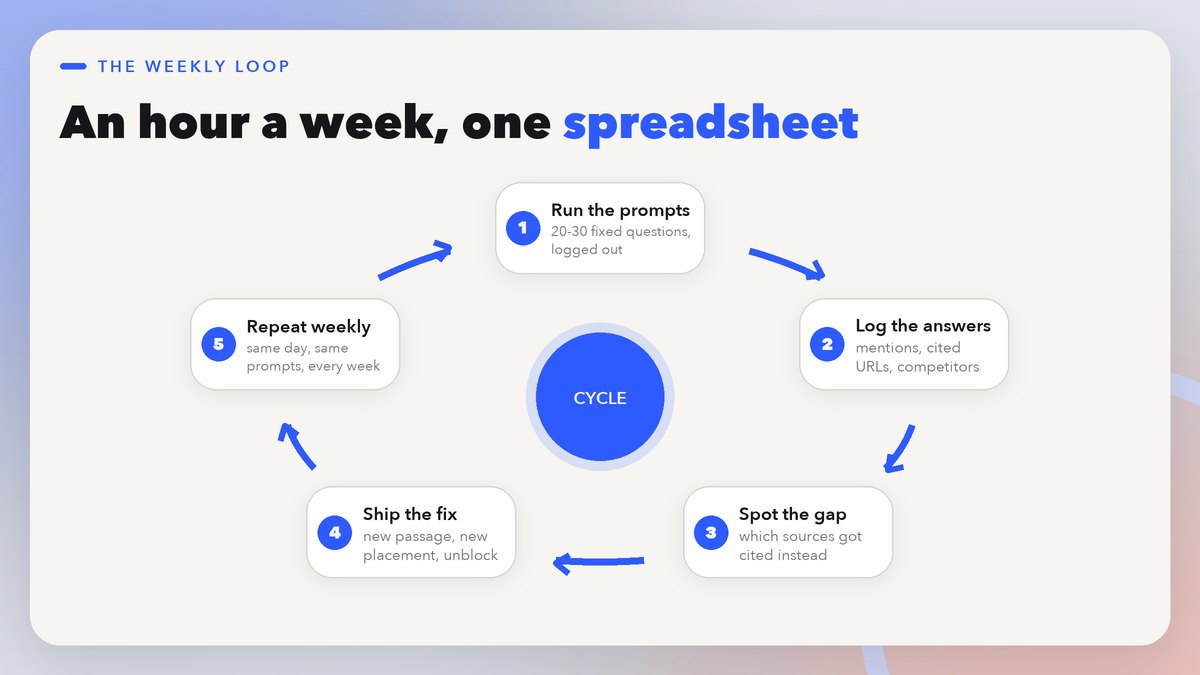
Once you’ve done four or five weekly runs by hand and the routine feels stable, that’s the moment to pay for a tool, and the buying criterion is simple: it should automate exactly the logging you were doing manually, on the engines you actually checked, with the prompt set you already validated. Buying first and designing the measurement second is how teams end up with a $99 add-on reporting a score nobody acts on. Whatever you use, keep the raw answers somewhere you control, because when a model update reshuffles citations overnight, the saved transcripts are the only evidence of what changed.
Getting cited: what moves the needle and what doesn’t
The tactics below are ordered by how well they hold up across all three engines rather than by how loudly they’re marketed, and the first one will annoy anyone hoping for a shortcut.
Rank still matters. Because AI Overviews are built from Google’s own index with query fan-out, pages that rank well for the fanned-out sub-queries get quoted, and the same correlation shows up in ChatGPT’s reliance on Bing for retrieval. If you’re invisible in classic search for a question, you’re close to invisible in the answers about it, so the technical audit and content-quality work you were already doing is the foundation here rather than a separate discipline.
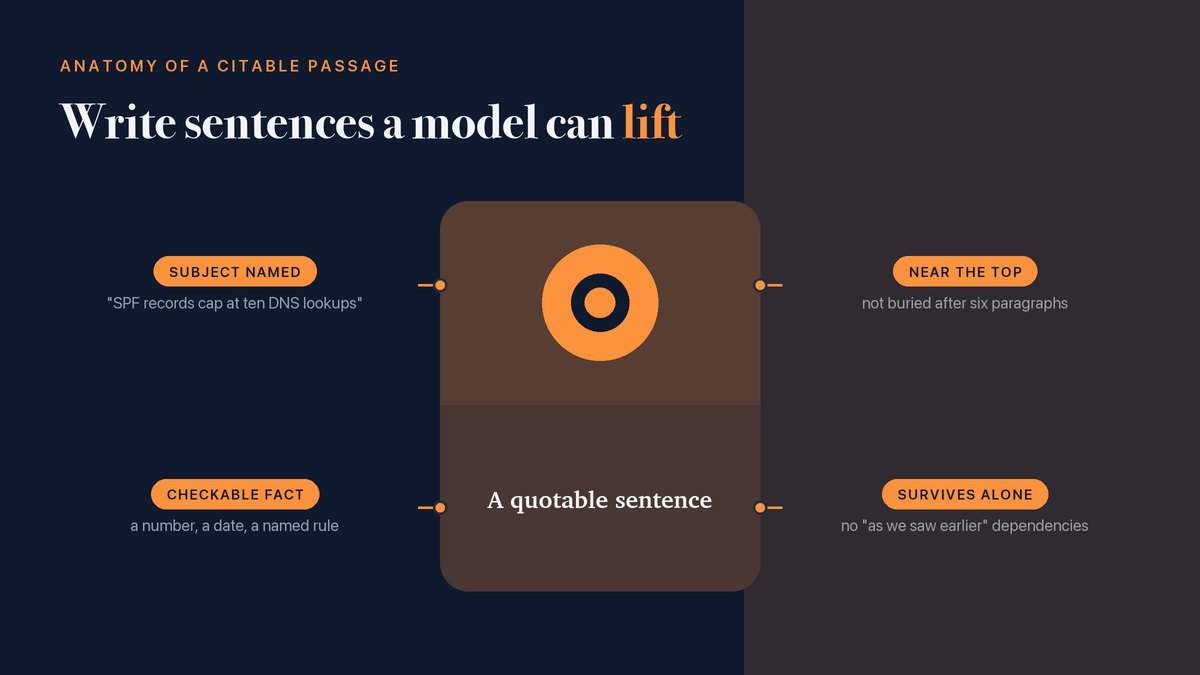
Write passages that survive being lifted out of context. An answer engine quoting you will take one or two sentences, so each sentence has to carry its subject with it. “SPF records cap at ten DNS lookups” works as a quotation; “as we saw earlier, this limit causes failures” falls apart the moment it’s pulled onto a results page. The pattern that earns citations is a short definitional or numerical statement, placed near the top of a section, that names its subject and states a fact a model can repeat without caveats. Pages structured as clear answers to real questions get lifted; pages that circle the point for six paragraphs get summarized from someone else.
Get present on the sources the engines already cite. Pew’s finding that Wikipedia, YouTube, and Reddit made up 15% of citations in AI summaries matches what every practitioner audit finds, and it means your YouTube explainer and your presence in the comparison articles ranking for “best X for Y” are citation surface area too. For most small brands the move with the best payoff in this whole article is unglamorous: get your product or your data into the third-party pages the engines trust, because a mention there is a mention the model will repeat even when it never links you directly.
Keep the crawler doors open and check them quarterly. The failure mode here is silent. A security plugin update, a Cloudflare bot-fight rule, or a robots.txt edit made for training-data reasons can block OAI-SearchBot or PerplexityBot, and nothing in your analytics will flag it because the traffic that disappears is traffic you never saw. Grep your server logs for OAI-SearchBot and PerplexityBot once a month, and treat a missing agent as an incident, the same way you’d treat a dropped ranking.
Freshness and specificity pull weight too. Answer engines prefer sources whose facts are current and checkable, so a page that says “as of November 2025, Semrush’s AI toolkit costs $99 per month per domain” gives the model something it can repeat with confidence, while a page that says “pricing is competitive” gives it nothing at all. Dating your claims and revisiting them is ordinary editorial hygiene that happens to be worth more in this channel than in classic search, where a stale page can coast on backlinks for years.
What to skip
The hype layer around this topic is thick, and two items deserve explicit skepticism. The first is llms.txt, a proposed Markdown file that would hand AI crawlers a curated map of your site. It was proposed in late 2024, no major engine has adopted it, and Google’s search team has said publicly that Google doesn’t use it, so in practice it’s an experiment to watch rather than a task to do. The second is any service promising guaranteed citations or a fixed “AI ranking,” because the engines themselves don’t have a stable ranking to sell you into; what these services deliver is usually the same third-party placement work described above, marked up and wrapped in vocabulary. The durable play is boring: be quotable, show up in trusted sources, keep the crawlers unblocked, and measure weekly so you notice when the answers change.
None of this replaces the classic funnel; it sits on top of it, catching the demand that now forms inside the answer box before a click ever happens. The sites that will look smart in two years are the ones that started logging their citations while the channel was still small enough to measure in a spreadsheet, and 20 prompts plus an hour a week is a cheap way to be one of them.