
Nielsen’s The Gauge, the measurement firm’s monthly read on what America watches, has put YouTube at the top of US television streaming for more than two years running. In its mid-2025 readings the platform accounted for roughly one in eight minutes of all TV time in the country, ahead of Netflix and ahead of every broadcast network’s streaming app. You can check the trend yourself on Nielsen’s Gauge data center. The rest of the picture comes from the platforms’ own announcements: YouTube reports on its official blog that viewers worldwide watch over a billion hours a day on television screens alone, and Alphabet’s quarterly earnings put YouTube ad revenue at about $36 billion across 2024. None of that sounds like a place where a freelancer with $500 to test has any business showing up.
The assumption that YouTube advertising belongs to brands with agency retainers is wrong in a specific way, and it’s worth being precise about why. The buy happens inside Google Ads, the same interface where a plumber in Toledo bids on “water heater repair.” Google sets no minimum budget at all, so the $500 in your account spends next to Procter & Gamble’s money without a separate door or a separate auction. What YouTube actually charges for is attention measured in seconds, and attention priced per view behaves differently from attention priced per click. A skippable in-stream ad that a viewer abandons at the five-second mark usually costs the advertiser nothing. That means a small budget doesn’t get outbid so much as it gets ignored, and those are different problems with different fixes.
This guide covers the four formats a small account can realistically buy, the auction mechanics that decide what a view costs, and a four-week test structure that fits inside $500. It also covers the measurement you can run without a brand-lift study, which has historically required spend in the tens of thousands of dollars before Google will run one for you. If you’re coming from search campaigns, expect the logic to feel upside down for about a week, because in this auction the viewer, not the bidder, decides whether money changes hands.
In this article
The four formats you’ll actually buy
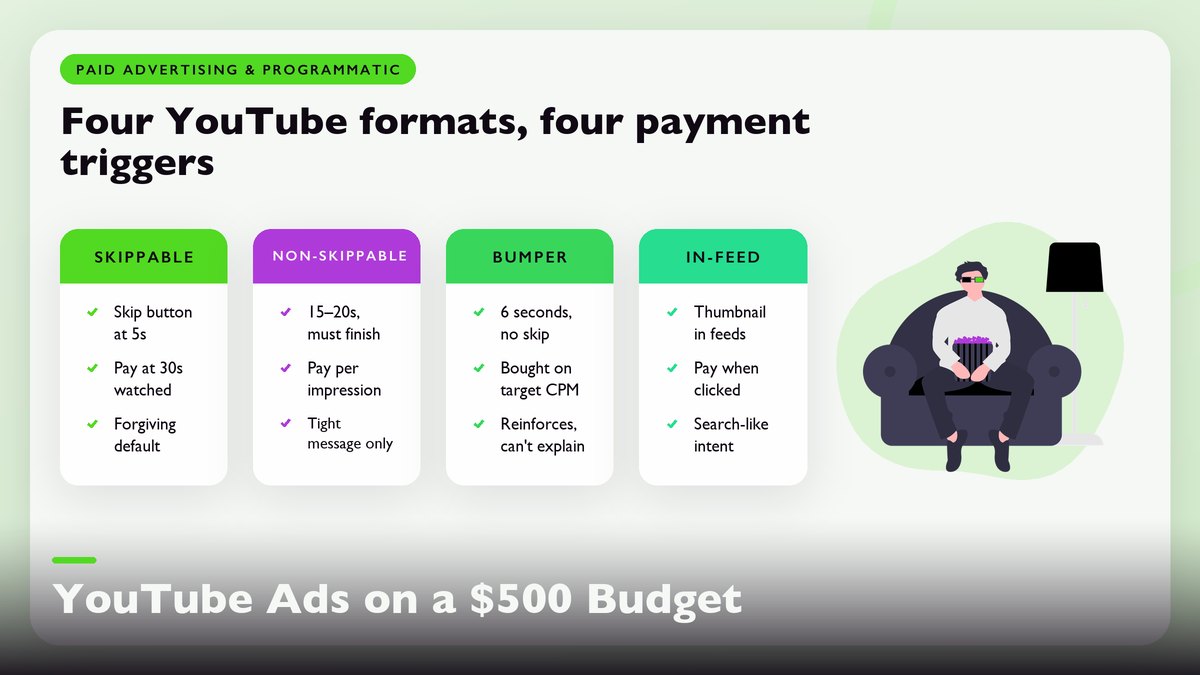
Google’s video campaign documentation lists more formats than a small advertiser needs. The useful move is to cut the list down to the four that matter below five figures of spend, and to learn the payment trigger for each, because the trigger is what makes one format forgiving and another one expensive.
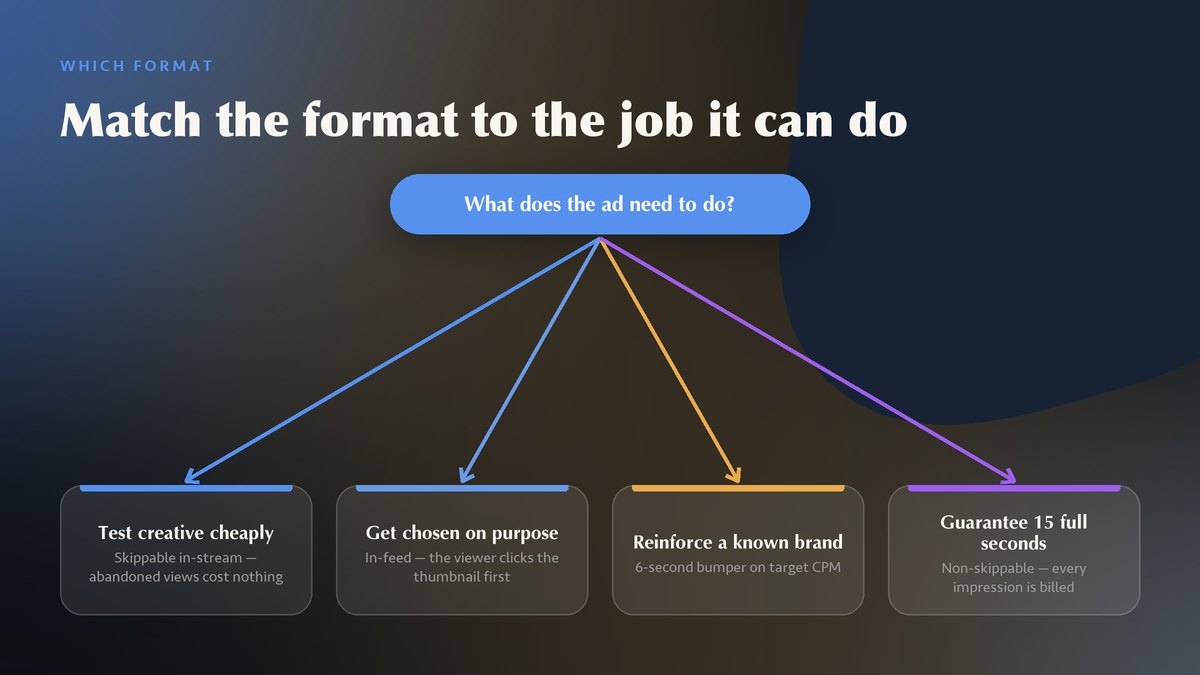
Skippable in-stream is the default and the one to learn first. The ad plays before, during, or after a video, the viewer gets a “Skip Ad” button after five seconds, and you pay only when someone watches 30 seconds, watches the whole ad if it’s shorter than that, or interacts by clicking through. Every abandoned view is free inventory for you. That’s why practitioners tend to treat the five-second skip point as the entire audition: if the first five seconds of your creative don’t give a stranger a reason to stay, the campaign will report a low view rate and a confusingly small bill. Both of those numbers are describing the same weakness in the opening.
Non-skippable in-stream runs 15 to 20 seconds depending on region, with 30-second versions available in some markets, and the viewer has to sit through all of it before the video starts. You pay on impressions rather than completed views, so the risk profile inverts: every impression costs money whether the person watches or walks to the kitchen. The format only earns its keep when the message genuinely needs 15 unbroken seconds. For a small advertiser that’s rare enough that non-skippable belongs later in the testing order rather than first.
Bumper ads are six seconds, non-skippable, bought on target CPM. They exist because of a specific constraint Google ran into when it introduced the format in 2016: advertisers wanted the guaranteed completion of non-skippable without paying for 15 seconds of a viewer’s resentment. Six seconds sounds unusable until you see what fits inside it, which is one idea delivered fast, usually a product shot and a claim. Google’s own 2017 analysis of early bumper campaigns claimed that a large majority drove measurable lifts in ad recall. You’d expect the platform selling the format to say that, but the underlying logic holds up anyway, since a six-second ad can’t explain anything and can only reinforce something the viewer already half-knows. That makes bumpers a second-campaign tool rather than a first one.
In-feed video ads, the format Google used to call video discovery, don’t interrupt anything at all. Your thumbnail and headline sit in the YouTube home feed, in search results, or beside the watch-next column. The view starts only when someone clicks the thumbnail, at which point you’re paying for a click that becomes a view. This is the closest YouTube gets to search behavior, because the person chose the video the way they’d choose a search result, and that makes in-feed the natural second format for anyone whose product needs more than six seconds of explanation.
Shorts ads deserve a mention even though you won’t buy them directly at this budget. YouTube reported 70 billion daily Shorts views back in 2023, and Shorts inventory now flows into broader video campaigns automatically. The practical implication is simple: a vertical cut of your creative, 9:16 and under 60 seconds, gives the system more placements to fill without any extra media buying on your side. Uploads have to live on YouTube itself, since Google Ads serves video from the platform rather than hosting files. Every ad you run is therefore accumulating organic view counts on your channel whether you planned for that or not.
What the auction actually charges
Cost-per-view on skippable in-stream inventory commonly lands between one and three cents in US auctions for reasonably targeted campaigns. Treat that range as an industry rule of thumb rather than a quoted rate, because Google publishes no rate card and the actual clearing price moves with the audience you pick and the season. Run the arithmetic at two cents and $500 buys on the order of 25,000 counted views, which is a genuinely useful sample for judging creative. It’s also far more people than a $500 search budget would touch in a competitive niche where a single click on “personal injury lawyer” can clear $50.
The mechanics underneath differ from search in one way that changes how you should bid. A search auction is a contest against other advertisers for scarce, declared intent, and the price reflects that scarcity directly. A video auction is a contest for a viewer’s next 30 seconds, and Google’s system is estimating, per impression, the probability that this particular person watches long enough for you to owe money. Target CPV bidding lets you state the most you’ll pay for a counted view. Setting it far below what the market clears at doesn’t save you money so much as it stops your ads from entering auctions at all, which shows up in the interface as low impressions and a daily budget that refuses to spend.
Two structural facts trim the reachable audience before you spend anything, and both are worth knowing so the delivery numbers don’t surprise you in week one. YouTube Premium passed 100 million subscribers in early 2024, and those viewers see no ads at all, so your effective audience is the ad-supported remainder rather than the full 2.5-billion-user figure you see quoted in pitch decks. The other fact sits on the supply side. Creators in the YouTube Partner Program keep 55% of the revenue from ads served against their videos, a split documented in Google’s Partner Program overview. That payment structure matters to you indirectly, because it’s the reason millions of channels keep uploading the inventory your ads run against.
Seasonality behaves the way it does in every ad auction, with fourth-quarter pricing inflated by retail demand, and a January test will usually clear cheaper than a November one for identical targeting. Industry analyses collected on Think with Google have been making the Q4-inflation point to advertisers for years. If your $500 window is flexible, that single calendar decision can be worth more than any bid adjustment you’ll make inside the account.
A $500 test, structured
The failure mode for small YouTube budgets is dispersion: five ad groups, three formats, and four audiences, with $4 a day spread thin enough that nothing accumulates enough data to mean anything after a month. The structure below concentrates the same money so each week answers exactly one question.
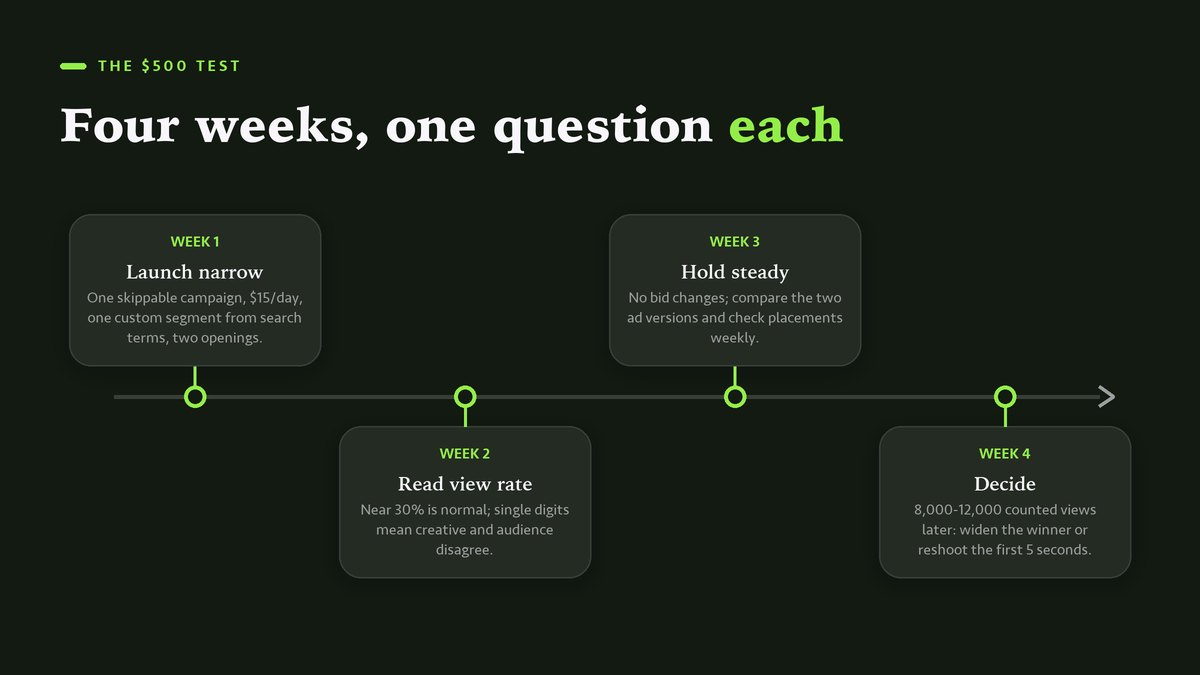
Week one belongs to one campaign, one format, and one audience. Build a single video campaign with skippable in-stream as the only format, and set a daily budget of $15. For targeting, pick one audience built as a custom segment from search terms. Custom segments let you describe your audience as the Google searches your customers actually type, which is the closest thing YouTube has to keyword targeting and the fastest way to make your first week resemble a market you understand. Upload two versions of the ad, ideally the same message with two different openings, since the five-second skip point makes the opening the variable that decides everything downstream.
The middle two weeks exist to read one number: view rate, the share of impressions that turn into counted views, which the format hands you for free. A skippable campaign running near 30% is doing roughly what practitioners consider normal. Single digits usually mean the audience and the creative disagree about who’s being addressed, and the cheapest diagnostic is comparing your two ad versions against each other before blaming the targeting. Resist touching bids during this stretch unless the budget isn’t spending at all; the temptation to fiddle is strong at $15 a day, and the data accumulating at that pace is too thin to justify it.
Week four is the decision week. By now you’ll have somewhere around 8,000 to 12,000 counted views if the CPV landed near the two-cent mark, enough to judge whether the creative holds attention and whether the audience behaves like buyers. The money question is whether any of those viewers did anything afterward, whether that means a site visit, a signup, or a purchase. If yes, the next $500 goes into widening the audience that produced them. If no, the honest read is usually the creative rather than the platform, and the cheapest fix is reshooting the first five seconds rather than raising bids.
Frequency deserves a hard look during the test, because small audiences plus daily budgets produce the same person seeing your ad eleven times. YouTube campaigns let you cap impressions per user per day or per week in the campaign settings. A cap of two or three impressions a day per person keeps the budget buying new viewers instead of re-serving the same ones, and it’s one checkbox most first campaigns leave unset.
Where small budgets go wrong
The mistakes cluster, and most of them come from importing search-campaign instincts into an auction that punishes them.
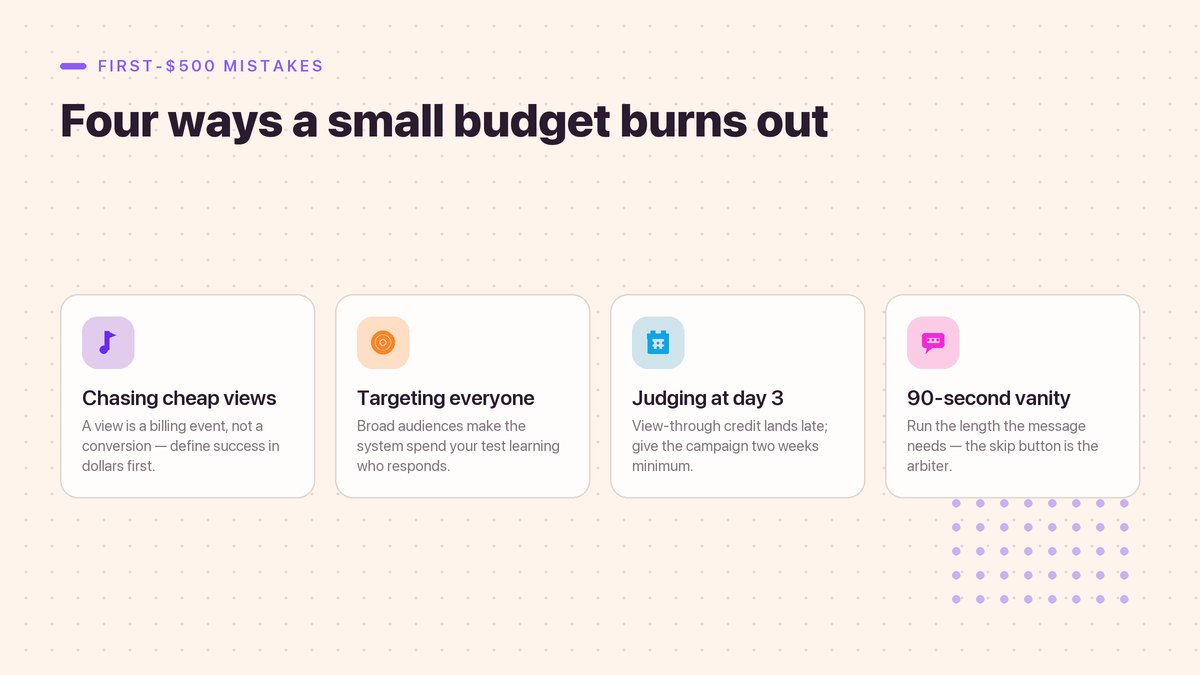
The most expensive one is optimizing for views as an end in themselves. A view on YouTube is a billing event, not a conversion, and a campaign tuned to maximize cheap views will go find the cheapest attention on the platform, which is not the same population as your customers. The fix costs nothing. Decide before launch what success looks like in dollars or signups, wire that action into Google Ads as a conversion, and read view rate as a diagnostic for the creative rather than as the goal.
The second mistake is the broad-audience reflex, and it usually surfaces in week one when “everyone might want this” feels like a targeting strategy. Broad targeting on YouTube means the system spends your test budget finding out who responds, and that education costs thousands of impressions a $500 test doesn’t have. Start narrow enough that you could describe the audience in one sentence, then widen from evidence rather than from hope.
The third is judging the campaign at day three. Video attribution runs on view-through windows, meaning someone can watch on Tuesday and buy on Friday and the campaign still gets partial credit depending on your settings, so an early read systematically undercounts what the ads did. Practitioners arguing about whether YouTube “works” usually disagree about attribution settings before they disagree about anything else. A two-week minimum before any kill decision keeps you out of that particular ditch.
The fourth is creative length vanity, the habit of running a 90-second cut because longer feels more substantial. A 90-second ad can work on skippable inventory since you only pay for viewers who stay, but most small advertisers don’t have 90 seconds of material that earns 90 seconds of attention. A 20-second cut that respects the viewer usually posts a better view rate than a longer one padded with a slow logo build. Cut to the length the message needs and let the skip button arbitrate.
Measuring without a brand-lift study
Google’s Brand Lift studies are the survey instrument that measures ad recall and consideration changes, and they have historically required spend in the tens of thousands of dollars before the platform will run one. That puts them permanently out of reach for a $500 test and mostly beside the point at that scale. What a small account can measure instead is more concrete, and most of it costs nothing beyond the attention to look.
Start with the earned-actions row in the YouTube interface, where shares, likes, comments, and subscribes attributed to the ad sit as free signals of resonance. Add view-through conversions in Google Ads with a window you chose deliberately rather than inherited, then connect the campaign to GA4 so you can watch what ad-viewers do on the site compared with everyone else. A cohort that bounces in four seconds is telling you the ad promised something the landing page doesn’t deliver. None of these instruments requires a rep or a minimum spend. Together they answer the only question a small test needs to answer, which is whether the next $500 goes into YouTube or somewhere else.
One more reading is worth doing while the test runs: pull the placements report to see which channels and videos actually served your ads. Small-budget campaigns on broad targeting occasionally land in content you’d never have chosen, and excluding the worst offenders is the cheapest quality improvement available to you. Check the report once a week during the test; it takes two minutes to read and it has ended more than one argument about why a campaign attracted the wrong traffic.
When YouTube is the wrong buy
Honesty about fit is cheaper than another failed test, and there are two situations where $500 belongs elsewhere. If you need conversions this week at a hard cost-per-acquisition, search and retargeting will beat YouTube almost every time. YouTube’s economics reward advertisers who can wait for attention to compound into demand, and that wait is measured in weeks rather than days. The second situation is having no video asset and no way to make one, because the format punishes static creative converted into a slideshow, which posts view rates low enough to poison the campaign’s early learning before you’ve spent $50.
One structural note for planning beyond the test: Google spent 2025 folding its older video action campaigns into Demand Gen. If a tutorial you find references “video action campaigns” by name, you’re reading something written before the consolidation and the settings have moved. Everyone else, particularly anyone whose customers research before they buy, is testing in the right place. The audience is measured in billions of hours, the entry bid is measured in cents, and the viewer who skips your ad costs you nothing while teaching you what to fix.
Keep reading
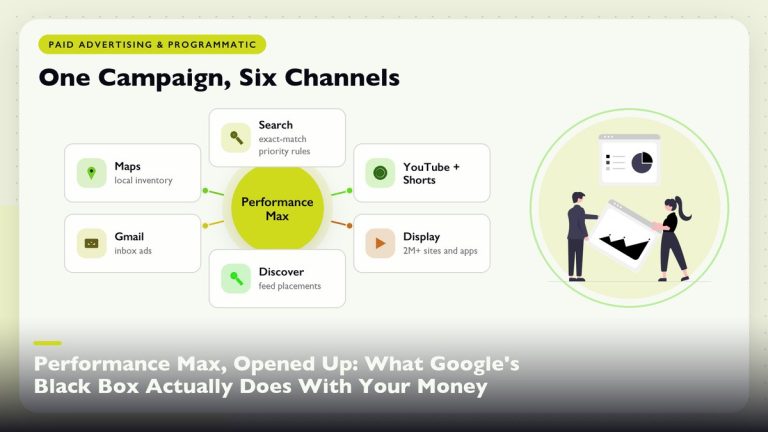 Paid Advertising & ProgrammaticPerformance Max, Opened Up: What Google’s Black Box Actually Does With Your Money
 Paid Advertising & ProgrammaticUnderstanding eCPM, RPM, and CPC: The Metrics That Decide Your Profit
 Paid Advertising & ProgrammaticGoogle Ads vs. Meta Ads: Where Your First $1,000 Should Go